|
Felix: Alright, the
first question: When did you first decide that art was
something you first wanted to do or even just be involved
with?
Tommy: My mom was a
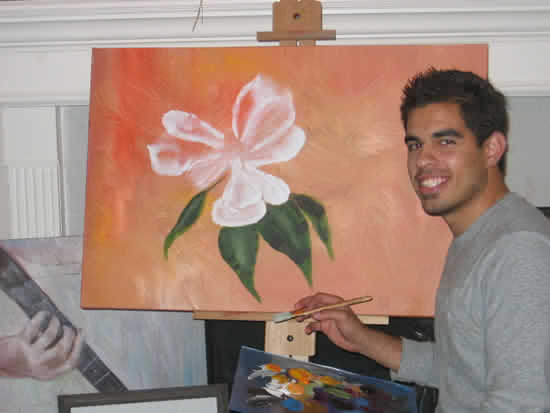
painter, so I’ve always sketched and I had a good time doing
that. But in high school I had a really good art teacher.
She was actually the one that game me that extra push that
you could do it. She let me know I could do it. You gotta
know you can do it. Eventually I realized it’s working to
get the the talent. It’s getting that extra little drive. So
I guess right after high school and coming to U of H, I was
torn between human resources or art. So I guess it was mom,
high school art teacher, and Paul Kittleson (U of H
Sculpture Director). He gave me that last little push and
was like it’s a career. You can be successful. You can
express yourself and make money.
Felix: What was one of
the first art projects that you were involved in when you
came to U of H?
Tommy: Mmm, the
biggest one would probably be the Public Art class I had
with Luis Jimenez. The Buffalo Bayou Art Park. Uh, did a
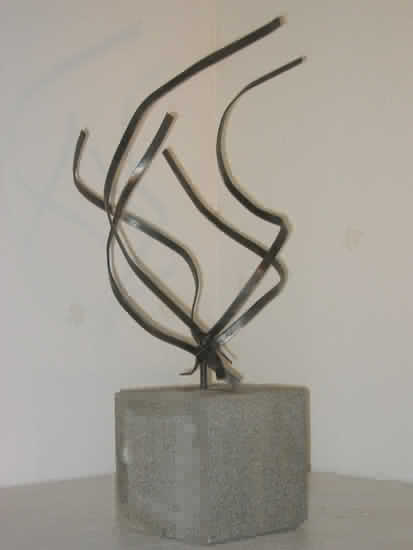
proposal there. Proposed “The Tornado” drawing to them and
they accepted it. I made it out of scrap metal. It stood
there for 2 years. That was probably the biggest, first big
sculpture ever I ever really did.
Felix: Who are some of
the instructors or those in the art world you’ve had the
privilege of working with?
Tommy: Luis
definitely. Probably the biggest one. And a big influence as
well.
Felix: When did you
hook up with him?
Tommy: Uhhh, 2 years
ago. But I first worked with him at his studio over spring
break. This past semester. And I got to learn a lot of good
techniques, working with fiberglass. Different kinds of
paint painting techniques. Him, and of course Paul Kittleson.
A guy here, he’s always been a big help and I guess
inspiration. So I’d say, those are the 2 guys.
Felix: What was one of
the first mediums you picked up? As far as when you first
started dealing in the arts.
Tommy: Drawing. I
always respected the pencil and the paper. As soon as I
started getting into the sculpture, metal was always the
preferred one. Its real hands on. Its forgiving too. You can
cut and put back together. Its fun to work with.
Felix: Do you remember
what year you first started working with the metal
sculpture?
Tommy: Probably my
sophomore year of college. My freshman year we didn’t
really get to play with it to much aside from wire
sculptures. It wasn’t really fun. It wasn’t bad, but you
don’t get the same joy out of doing wire sculpture that you
do out of welding and using a settling torch or something
like that. Umm, plasma cutters. You get to play with a lot
of tools which gives you more broad skills.
Felix: In working with
some of these different instructors or umm, I guess
apprenticeships under some of these great artists, what are
some of the cities you’ve had the privilege of going to?
Tommy: Honda in
Mexico. Umm that’s where I worked with Luis. I worked in
Austin. I’ve worked in Bastrop. These are small towns, well
Austin's not a small town. But Bastrop is a small town. We
helped clear out some land there and did some wood
sculptures. Some carvings. It was fun.
Felix: What is your
opinion of the Houston art scene at this point from what
you’ve seen?
Tommy: Its blowing up.
It’s getting big. I guess it’s always had a good community
of artists, but now you’re getting gallery owners. You’re
getting like, what ya’ll are doing. People actually, doing
something to expose it. Let people outside of Houston see
what artist here have to offer. Like Caren Olivier. She’s a
New York artist but she teaches here. She could probably
teach anywhere she likes, but she chose University of
Houston. Art is changing as well as the Houston scene. You
have a contemporary time period that’s giving people so many
ways to do artwork. Video. You know…music. Aside from just
visual, what you see hanging on the wall. That’s not just
art anymore. There’s so many different levels.
Felix: What do you see
as the next 1 or 2 next big trends here in the Houston area?
Or even probably nationwide?
Tommy: Video arts
getting really big. A lot of good video installations by
local artists and Houston artist and outside artists
that…you know, found a home here. But video arts getting
pretty big.
Felix: How do you keep
up with what's going on in the art world as far as trends
and who’s hot? Who's up and coming?
Tommy: Websites. I’m
always told about a different website that’s good to check
out. You know, new artists or new techniques. Or new shows,
something's going on. Word of mouth has always been good. I
try to shake the right hands in the art world. Commerce
street downtown has a lot of good, has a big art community.
And I go down there. They have art openings all the time.
Felix: Who are some of
the artists that you may have read about or been to their
website and just said,”Hmm, I really want to work with himor
her”?
Tommy: Of hand,
Bottego. She’s a, I guess more of a modern artist. I’ve seen
her work and it just reminds me of some sketches that I’ve
done, but never been able to take to the next step. And you
know, she’s already done it. And I’d like to maybe one day
work with somebody on that scale. But that’s like somebody
untouchable. Or untouchable right now. But hopefully one
day….
Felix: So what's next
in the immediate future for the next month or so? For
yourself as far as projects that you're working on or shows?
Tommy: Next, I’m going
back to Hondo, New Mexico where I’ll continue working with
Luis on this ‘Mustang’ that’s going to the Denver National
Airport. A big fiberglass sculpture. And then actually next
week, I haven’t talked to Paul but, I think Paul Kittleson
is putting in the stainless steel ‘Towers’ in front of the
Toyota Center. And actually I’m working on a commission for
a painting. After that hopefully more things will be coming
along. |